
These include Goldman Sachs, HSBC, UBS, Deutsche Bank, Barclays, RBS, Citigroup and JP Morgan and they have said in their respective regulatory filings that they are cooperating with the relevant authorities in the investigations.

Finance Minister Nirmala Sitharaman on Tuesday asked fintech firms to focus on risk management at a time when criminals are using AI to mimic voices, clone identities and create lifelike videos to manipulate people.

The rupee dropped to nearly 9 months low of 56.01 to the dollar on Thursday.

The rupee declined 22 paise to 87.41 against the US dollar in early trade on Thursday after the latest tariff announcements from the US weighed on emerging currencies, including the rupee. Forex traders said the latest tariff announcements from the US have sent shockwaves through global markets, strengthening the dollar.

'The brand, the team, and the people have to make the transition from playing league matches to Test matches.'

The Indian Rupee is the fourth most depreciated currency in the world and most depreciated in Asian continent.

A combination of factors, including heavy investments in US Treasury bonds and dollar sales at a healthy profit, facilitated the Indian central bank in transferring a record surplus of Rs 2.11 trillion to the government for 2023-24 (FY24). The RBI's dollar purchases increased in FY24, supported by robust capital inflows endorsing the economy's health.

'India has the potential to grow at more than 7%, with the monetary policy providing a supportive hand.'

'Many global investors have been overweight on dollar assets, so some diversification or hedging is naturally expected.'

The country's largest airline IndiGo on Friday saw its profit after tax slide 18.3 per cent to Rs 2,448.8 crore in the three months ended December 2024 due to foreign exchange loss even as revenue jumped on higher capacity and passenger traffic. The carrier, which had a fleet of 437 planes at the end of December, is planning to induct wet leased planes for long range flights and expects the number of grounded aircraft to come down to 40s by the start of next financial year from the current level of 60s.


The rupee remains overvalued against the currencies of India's trading partners, even as it hit record lows against the dollar in August and September. According to the Reserve Bank of India's (RBI) real effective exchange rate (REER) index, the rupee stood at 5.5 per cent above its fair value in August, down from 7.7 per cent in July. This slight easing followed fears of a US recession and the unwinding of yen carry trades, which exerted pressure on the Indian currency.

Propelled by strong demand and lower costs, the country's largest airline, InterGlobe Aviation (IndiGo), reported solid operational performance in the 2024-25 (FY25) October-December quarter (Q3). While demand was driven by the festival season, year-end increase, and higher consumer spending, lower fuel and rental costs helped deliver a beat at the operating profit level.
The country's foreign exchange reserves continued to surge ahead and for the third week in a row crossed the $1.5 billion mark.

'If it doesn't, it will continue with measures to infuse liquidity, signalling a new cycle,' predicts Tamal Bandyopadhyay.
Also, there were not many clients in the market as they had already made alternate arrangements due to the strike.

'While investors believe in India's long-term growth story and resilience amid global uncertainty, they see near-term risks around the direction of a global trade war.'

'A repo cut will be very good for the market as it will mean that everything is being done to spur growth in these uncertain times.'

Escalating trade tensions amid a tariff war after Donald Trump took over as President of the United States (US) could adversely impact global growth and fuel inflation, an article on the "State of the Economy" in the Reserve Bank of India (RBI) monthly bulletin said.
India's foreign exchange reserves grew further by $899 million to touch $107.5 billion for the week ended February 13.
The country's foreign exchange reserves went up by $761 million to $104.998 billion in the period under review, according to Reserve Bank of India's weekly statistical supplement released in Mumbai on Saturday.
India's foreign exchange reserves rose by $2.03 billion at $142.6 4 billion, according to Reserve Bank of India's weekly statistical supplement released in Mumbai on Saturday.

India's foreign exchange reserves increased to $604 billion as on December 1, surpassing the $600 billion mark after a gap of about four months. The forex reserves were last above the $600 billion mark on August 11 this year. "India's foreign exchange reserves stood at $604 billion as on December 1, 2023.
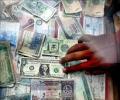
The forex kitty swelled for the fifth week in a row during the week ended December 6 to $295.71 billion, adding $4.41 billion. Between August 30 and December 6, the reserves have increased by close to $17 billion.
India's foreign exchange reserves surged further by $1.6 billion to cross the $106 billion mark for the week ended February 6.

The Real Effective Exchange Rate (REER) of the rupee moderated in December to 107.20 after hitting a peak of 108.14 in November, latest data released by the Reserve Bank of India (RBI) showed. The REER was 103.66 in January 2024. The rupee depreciated around 3 per cent against the dollar in 2024.

The recent depreciation of the rupee along with sharp fall in the country's foreign exchange (FX) reserves has sparked a debate whether stability of the exchange rate is necessary and desirable. The rupee was one of the least volatile currencies among peers for almost two years before the current downward pressure started in September after the US Federal Reserve lowered interest rate.

The first quarter earnings season will dictate the trend in the equity markets in this holiday-shortened week amid absence of major macroeconomic drivers, say analysts. Besides, lacklustre global markets may increase volatility in the market, they added. Equity markets would remain closed on Wednesday for Bakri-Id.

Corporate India is more dependent than before on exporters of IT services such as Tata Consultancy Services (TCS), Infosys, and Wipro for earning foreign exchange. Such companies account for nearly 43 per cent of the forex revenues of listed firms, up from 22 per cent a decade ago. The listed IT services companies earned nearly Rs 4.2 trillion through exports in FY22, up 15 per cent from the Rs 3.65 trillion a year earlier. In comparison, the forex revenues or exports of the rest of the BSE500 companies were down 11.9 per cent to Rs 5.6 trillion last financial year.

The RBI added roughly 3 tonnes in 2025, taking its gold reserves to 879 tonnes as of January 31, 2025.

Bajaj Finance was the top gainer in the Sensex pack, rallying over 4 per cent, followed by SBI, Tech Mahindra, Asian Paints, Bajaj Finserv, IndusInd Bank, ICICI Bank and M&M.

A trends study conducted by India's Financial Intelligence Unit (FIU) has expressed suspicion that cryptocurrency is being used across the country in serious criminal acts like terrorist financing, fuelling secessionist activities, cybercrime, narcotics trafficking, illegal betting and gambling. The report, which was based on suspicious transaction reports and operational analysis, shared these trends and credible intelligence with law enforcement agencies.

The rupee appreciated 6 paise to 78.27 against the US dollar in opening trade on Monday as heavy buying in domestic equities and weakness in the greenback strengthened investor sentiment. However, elevated crude prices and persistent foreign fund outflows restricted the rupee's gain, forex dealers said. At the interbank foreign exchange, the rupee opened sharply up at 78.24 against the US dollar, then inched lower to quote 78.27, registering a gain of 6 paise over the last close.

While liquidity in the banking system has turned surplus in the last few weeks, it could go back to deficit again, mainly due to corporate advance tax outflows. The net liquidity surplus of the banking system rose to touch Rs 1 trillion on Tuesday on the back of government spending, according to the data released by the Reserve Bank of India.

Dr Reddy's, Maruti, Bharti Airtel, Bajaj Auto, Infosys, TCS and Bajaj FinServ were the major losers. On the other hand, IndusInd Bank, Sun Pharma, ICICI Bank and HDFC Bank ended with gains.

In the biggest weekly increase in over a year, India's forex reserves swelled by $6.56 billion to reach $531.08 billion for the week ended October 28, RBI data showed on Friday. The overall reserves, which have been on a declining spree for many months now, had dropped by $3.85 billion to $524.52 billion in the previous reporting week. The $6.5 billion jump in the reporting week is the highest since September 2021.

After a robust 2023, foreign investors significantly scaled back their investments in Indian equities in 2024, with net inflows amounting to over Rs 5,000 crore, as elevated domestic valuations, coupled with geopolitical uncertainties prompted investors to adopt a more cautious stance. Looking ahead to 2025, FPI flows into Indian equities could see a recovery, supported by a cyclical upswing in corporate earnings, particularly in domestic-oriented sectors like capital goods, manufacturing, and infrastructure, Vinit Bolinjkar, head of research, Ventura Securities, said.

Sir Osborne Smith was the first governor of the Reserve Bank, serving from April 1, 1935, to June 30, 1937.
The rupee depreciated by 22 paise to close at a fresh lifetime low of 79.48 (provisional) against the US dollar on Monday, tracking a strong greenback overseas and subdued domestic equities. However, receding crude oil prices in the international market restricted the rupee's loss, forex traders said. At the interbank forex market, the local unit opened weak at 79.30 against the greenback and witnessed an intra-day high of 79.24 and a low of 79.49.
